


Over five billion plastic tees are discarded into landfills every single year, creating a staggering environmental footprint for a sport defined by its connection to nature. It’s a common frustration to reach into your bag only to find warped plastic that’s lost its shape or to feel the guilt of leaving non-biodegradable debris on a pristine fairway. You deserve equipment that reflects your commitment to both the game and the land. When evaluating bamboo tees vs plastic tees, many discerning players are realizing that sustainability doesn’t require a sacrifice in strength.
In this guide, you’ll discover how high-tensile bamboo provides a sophisticated engineering upgrade, offering the rigidity of hardwood with a resilience that lasts for multiple rounds. We’ll explore the latest 2026 performance benchmarks and material science to show you why transitioning to bamboo is the smartest move for your game and the environment. We’ll examine how these sustainable tools provide cleaner contact at impact, ensuring your setup is as precise as it is eco-conscious. This journey through modern golf essentials will help you refine your gear with meticulous care and professional standards.
Key Takeaways
- Discover why bamboo possesses 1.5x the tensile strength of traditional wood, providing a superior foundation for your most powerful drives.
- Analyze the performance trade-offs of bamboo tees vs plastic tees to understand how material rigidity influences ball launch and spin rates.
- Learn why the shattering nature of bamboo is actually a performance advantage that ensures maximum energy transfer directly to the golf ball.
- Identify the professional standards for tee selection that help you maintain a more consistent and repeatable setup on every hole.
- Explore how to curate a high-performance kit by pairing eco-conscious accessories with sophisticated, technical apparel.
The Evolution of the Tee: Why Material Choice Matters in 2026
The modern golfer understands that excellence is found in the details, and even the humblest accessory in the bag has undergone a radical transformation. While early players relied on hand-molded mounds of sand, the history of the golf tee shows a steady progression toward more refined, engineered solutions. We’ve moved past the era where a tee was a mere commodity, transitioning from traditional cedar to the convenience of plastic, and finally to the high-tensile strength of bamboo. In 2026, the debate over bamboo tees vs plastic tees isn’t just about price; it’s a fundamental question of technical performance and environmental stewardship.
Choosing the right material affects the rigidity of your setup and the friction generated at the moment of impact. Discerning players now view their tees as critical technical equipment, recognizing that a consistent launch requires a stable platform. This shift in mindset reflects a broader commitment to precision, where every component of the game is selected with meticulous care to ensure reliability and superior standards.
The Problem with Plastic in the Modern Game
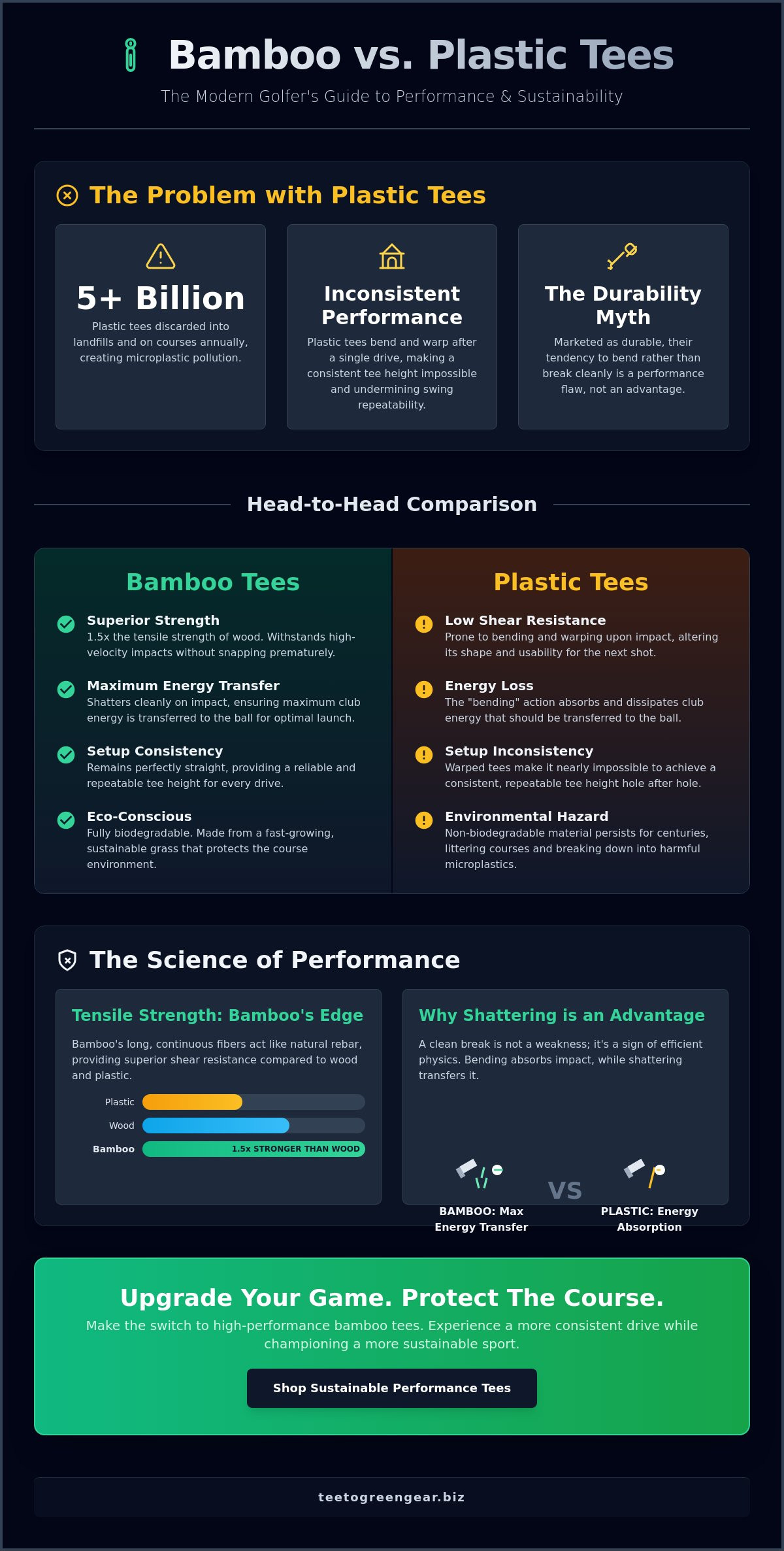
Plastic tees were once lauded for their durability, yet they’ve become a source of frustration for the performance-oriented golfer. Unlike natural materials that break cleanly, plastic often suffers from a “bending” phenomenon where the shaft warps after a single drive. This subtle deformation makes it impossible to achieve a consistent height on the next hole, undermining your swing’s repeatability and confidence. Beyond the tee box, the hidden cost of these non-biodegradable accessories is significant. With over 5 billion plastic tees ending up in landfills or left on courses annually, the accumulation of microplastics is now a primary concern for premium course maintenance. These synthetic fragments persist for centuries, disrupting delicate soil ecosystems and creating long-term liabilities for the clubs we cherish.
Bamboo: The Grass That Acts Like Steel
Bamboo represents a sophisticated middle ground, offering a cellular structure that’s fundamentally different from traditional hardwoods. As a fast-growing grass rather than a tree, bamboo features long, continuous fibers that provide exceptional tensile strength and a natural “spring” effect during impact. Research indicates that bamboo is approximately 1.5x stronger than standard wood, allowing it to withstand the high-velocity forces of modern drivers without the brittle snapping associated with cedar. When comparing bamboo tees vs plastic tees, the natural fiber alignment of bamboo allows for a rigid, stable strike that doesn’t sacrifice the integrity of the course. It’s a material that feels both traditional in its elegance and revolutionary in its performance capabilities.
Material Science: Tensile Strength and Friction Analysis
Engineering a consistent drive requires more than just a refined swing; it demands a deep understanding of the mechanical interface between the ball and the tee. When comparing bamboo tees vs plastic tees, the most significant differences are found at the microscopic level. Bamboo isn’t just sustainable. It’s a high-performance material that offers 1.5x the tensile strength of traditional hardwood. Strength isn’t just marketing. It’s a functional advantage that provides a more stable platform during the critical milliseconds of impact.
Tensile Strength and Shear Resistance
Shear resistance is the ability of a material to withstand forces that cause its internal structure to slide against itself. During a high-velocity driver strike, the tee is subjected to immense lateral pressure. Bamboo’s unique cellular architecture consists of long, continuous fibers that run the entire length of the shaft. These fibers act like natural rebar, resisting the snapping forces that typically claim cedar or pine alternatives. An academic study on golf tee materials highlights how natural fibers can outperform synthetic composites in specific stress environments. By choosing bamboo, you’re utilizing a material that manages energy transfer with professional-grade precision.
The Physics of the Launch
While many players focus exclusively on clubhead speed, friction plays a subtle but decisive role in ball flight. Many plastic tees are marketed as “zero-friction,” yet their smooth, molded surfaces can actually lead to inconsistent ball seating. If the ball isn’t perfectly stable, you risk microscopic shifts during the downswing that can alter spin rates. Bamboo provides a natural, matte finish that offers just enough tactile grip to keep the ball centered without adding drag. This stability is essential for modern high-MOI drivers that are sensitive to even the slightest off-center strike. Precision starts at the base.
Extreme summer heat often compromises the structural integrity of synthetic accessories. Plastic is a thermoplastic material, meaning it softens and loses its rigidity as temperatures rise on a summer afternoon. A softened tee can flex prematurely, leading to a “mushy” feel at impact and unpredictable launch angles. This is a common frustration when comparing bamboo tees vs plastic tees during peak season play. Bamboo remains perfectly rigid regardless of the thermometer, ensuring your 18th hole feels exactly like your first. If you’re ready to upgrade your bag with equipment that matches your commitment to excellence, you can explore our collection of durable golf tees today.
Durability Debunked: Shattering vs. Bending
Understanding the difference between structural durability and functional utility is essential for any serious golfer. When we analyze bamboo tees vs plastic tees, the conversation often centers on which material lasts through more holes. While plastic is resilient, it frequently falls into the “Bent Tee” Trap. A plastic tee that has warped or curved after a single drive is functionally broken, even if it hasn’t snapped into pieces. It creates an unstable, tilted platform that compromises your ball’s position and alignment. This subtle deviation can lead to inconsistent spin rates and a loss of confidence before you even begin your backswing.
Bamboo, by contrast, is designed for a clean and decisive failure. When the forces of a modern driver exceed its high-tensile limit, it shatters into organic fragments rather than deforming. This shattering action is a sophisticated way to manage energy at impact. Some players worry that a breaking tee absorbs energy that should go to the ball, but the reality is the opposite. A tee that snaps instantly offers less resistance to the clubface than a plastic one that bends and drags along the sole of the driver. It’s a matter of precision versus persistence.
The Case for Controlled Failure
A tee that snaps cleanly provides superior protection for your equipment and your stats. At the 100+ mph swing speeds common in 2026, you want the tee to yield immediately upon contact. Bamboo is engineered to withstand the vertical pressure of the ball while providing a predictable failure point during the strike. This ensures that the energy of your swing is directed toward the ball’s core rather than being wasted on a flexible plastic shaft. While a single bamboo tee typically lasts between 5 to 10 drives, it maintains its perfect shape for every one of those shots. Plastic might technically survive more holes, but it often becomes unusable due to warping after just a few swings. You don’t want to play with compromised gear.
The Environmental Scorecard
From a maintenance perspective, course marshals and greenkeepers have a strong preference for natural materials. Plastic bends that stay embedded in the turf can wreak havoc on precision mower blades, leading to costly repairs and uneven fairway heights. Bamboo shards are organic and pose no threat to machinery or the environment. Beyond the course, the timeline for biodegradation is the ultimate deciding factor. Bamboo breaks down in approximately 4 months, while plastic can persist for up to 400 years. As a discerning player, choosing the right accessories is part of your responsibility to the land. You can find more details on this balance in our guide to Bamboo vs Plastic Golf Tees. It’s about ensuring your legacy on the course is defined by your score, not your waste.
Strategic Selection: Optimizing Your Bag for Consistency
Precision in golf often focuses on clubhead technology or ball compression, but the foundation of every drive begins with the tee. Consistency in your consumables leads directly to consistency in your swing; when you eliminate variables like material flex and height variation, you create a repeatable environment for success. The choice between bamboo tees vs plastic tees is a strategic decision that affects your psychological readiness as much as your physical launch. A bag filled with uniform, high-quality equipment signals a commitment to excellence that carries through to every aspect of your game.
What Kind of Tees Do Pros Use in 2026?
In 2026, the trend among elite players has shifted decisively toward natural, high-performance materials. Many professional tournaments have moved to restrict plastic accessories to protect course maintenance equipment and soil health, but the shift is also driven by performance. Top-tier players prefer the crisp, tactile feedback of bamboo at impact, which offers a distinct “click” that feels more connected than the dull thud of synthetic alternatives. The 2 3/4″ bamboo tee has emerged as the professional standard for modern drivers, as it provides the optimal height for high-MOI clubheads without the unpredictable flex of a warped plastic shaft. You can explore the technical details in our analysis of what kind of tees do pros use to see how these standards are evolving.
Bag Organization and Preparation
A disciplined bag reflects a disciplined mind. The “15-Tee Rule” is a simple yet effective way to ensure you’re prepared for an 18-hole round without the distraction of searching for broken remains. While bamboo is 1.5x stronger than standard wood, carrying a uniform set of 15 fresh tees prevents the need to reuse equipment that might have suffered microscopic stress. To maintain the meticulous care put into their craftsmanship, store your bamboo tees in a dry, partitioned pocket. This prevents moisture absorption, ensuring they maintain their maximum rigidity for every drive. Integrating these with other precision tools, like a magnetic ball marker, creates a streamlined pre-shot routine that fosters focus and calm.
On days when the tee box is baked hard by the sun, the debate over bamboo tees vs plastic tees is settled by sheer piercing power. Bamboo’s long, natural fibers allow it to penetrate sun-baked ground where plastic might buckle or traditional wood might splinter during the setup. This reliability allows you to focus entirely on your target rather than struggling with your equipment. If you’re ready to bring this level of professional consistency to your next round, you can shop our professional-grade bamboo tees and experience the difference of a truly optimized bag.
The Performance Kit: Integrating Bamboo into Your Game
True performance on the course is achieved when every element of your gear works in harmony. While many focus on the major investments, the discerning golfer knows that a high-performance kit starts with the smallest accessory. Integrating sustainable bamboo into your setup is more than an environmental choice; it’s a commitment to a refined, cohesive aesthetic that values precision from the ground up. When we weigh the merits of bamboo tees vs plastic tees, the decision becomes a reflection of your overall approach to the sport. It’s about choosing quality that lasts and materials that respect the traditions of the game.
The modern golfer seeks an aesthetic that is clean, functional, and deeply eco-conscious. Pairing high-tensile bamboo with elite technical apparel, such as our Performance Tech Polo, creates a synergy of comfort and capability. This holistic view of the game ensures that your physical performance is supported by moisture-wicking fabrics and your mental focus is anchored by reliable hardware. By curating your bag with meticulous care, you eliminate the distractions of subpar equipment, allowing your skill to take center stage.
Craftsmanship in Every Detail
Every product we offer is born from a Veteran-Owned commitment to quality and a passion for excellence. We apply the same meticulous care to selecting sustainably sourced bamboo as we do to the design of our Classic Logo Snapback. This dedication ensures that your gear doesn’t just look professional but also performs under the most demanding conditions. A unified look, from your performance-engineered golf snapback hats to your consumables, signals a level of preparation that commands respect on the first tee. It’s this intersection of functional improvement and aesthetic refinement that defines the discerning insider.
Taking the Next Step
The permanent upgrade to bamboo is a logical conclusion for those who prioritize strength, speed, and sustainability. As we’ve explored throughout this guide, the bamboo tees vs plastic tees debate is settled by the superior tensile strength and cleaner impact of natural fibers. You no longer have to settle for warped plastic or brittle hardwood. Instead, you can rely on a tool that’s engineered for the 2026 game while remaining completely biodegradable. It’s time to audit your bag and remove the synthetic variables that hold you back.
We invite you to experience the difference that professional-grade consumables can make in your repeatable swing. Elevate your equipment standards and align your game with the principles of craftsmanship and conservation. You can shop our Bamboo Golf Tees now and complete your high-performance kit with the gear you deserve.
Master the Details for a Superior Drive
Selecting premium equipment is a deliberate step toward mastering the intricate nuances of your game. The structural integrity of bamboo provides a more stable launch than synthetic alternatives, ensuring your setup remains consistent from the first hole to the last. By choosing a material that is 1.5x stronger than traditional wood, you’re investing in a foundation of strength that supports your most powerful swings with professional-grade reliability.
Deciding between bamboo tees vs plastic tees defines your commitment to both technical precision and environmental stewardship. Our 100% biodegradable offerings reflect a deep respect for the land, while our Veteran-owned standards ensure that every piece of gear meets the highest expectations for durability and craftsmanship. It’s time to audit your bag and embrace a refined setup that mirrors your passion for excellence. Elevate your standards and experience the difference that meticulous material selection makes on every fairway.
Upgrade to Sustainable Performance with Bamboo Golf Tees
We look forward to seeing you achieve your best on the course and helping you refine your journey toward a more sustainable, high-performance game.
Frequently Asked Questions
Are bamboo golf tees really stronger than plastic?
Bamboo possesses superior tensile strength compared to plastic, although plastic is characterized by its flexibility rather than its structural rigidity. While plastic often warps and bends after a single strike, bamboo provides a stiff, reliable platform that is 1.5x stronger than standard hardwood. This inherent strength ensures your ball stays perfectly positioned for a consistent launch every time you step onto the tee box.
Do bamboo tees break as easily as wooden ones?
Bamboo is significantly more resilient than traditional cedar or pine alternatives due to its unique cellular architecture. Its long, continuous fibers resist the snapping forces of high-velocity impacts, often lasting through 5 to 10 drives before needing replacement. This durability makes it a much more reliable choice for the modern golfer who demands high-end performance from every accessory.
Are bamboo golf tees biodegradable?
Bamboo tees are 100% biodegradable and typically return to the earth within four to six months. This rapid decomposition is a primary factor in the bamboo tees vs plastic tees debate, as synthetic alternatives can persist in the environment for up to 400 years. Choosing bamboo allows you to maintain a professional bag setup while fulfilling your responsibility to the land you play on.
Why are many golf courses banning plastic tees in 2026?
Many elite courses are implementing these bans to safeguard their expensive mowing equipment and preserve soil integrity. Plastic fragments can damage precision blades and lead to long-term microplastic contamination that natural materials simply avoid. By transitioning to bamboo, you’re aligning your game with the highest standards of course maintenance and environmental stewardship.
Can bamboo tees improve my driving distance or accuracy?
Bamboo improves consistency by offering a rigid strike surface that doesn’t flex or drag during the moment of impact. This stability ensures that the energy from your driver is transferred directly to the ball’s core, promoting the predictable launch conditions required for maximum carry. A more stable platform at the base of your drive naturally leads to better accuracy over time.
How many rounds can I expect to get out of a single bamboo tee?
A single bamboo tee is designed to withstand multiple drives across several rounds of high-performance play. Most golfers find that a small set of 15 tees is more than sufficient for a full 18 holes, as the material’s natural resilience prevents the premature failure common in cheaper wood alternatives. It’s a durable solution that reflects the meticulous care put into its craftsmanship.
Do bamboo tees leave marks on my clubface?
Natural bamboo will not leave the stubborn, synthetic streaks often associated with painted or molded plastic accessories. This helps maintain the aesthetic appeal and performance of your driver face, ensuring your equipment remains in pristine condition. Using natural materials is a sophisticated way to protect your investment in high-end club technology.
Is there a specific height of bamboo tee I should use for my driver?
The 2 3/4″ height is widely regarded as the professional standard for modern, high-volume drivers in 2026. This specific length allows you to position the ball perfectly relative to the clubhead’s crown, promoting the high-launch and low-spin conditions required for elite distance. Selecting the correct height is a critical step in optimizing your bag for total consistency. To complete your on-course look with the same attention to detail, explore our guide to choosing golf snapback hats engineered for style and performance in 2026.
Disclaimer
“Tee To Green Gear utilizes modern content and SEO technologies to help deliver golf-related articles, product insights, and apparel content. All published material is reviewed for quality, accuracy, and brand consistency.”
