


According to recent data, 50% of golfers violate at least one USGA rule during their round. While many of these infractions involve complex relief situations, a surprising number occur right on the putting green due to a simple misunderstanding of golf ball marker etiquette. It’s a common source of anxiety for many players who fear that a misplaced coin or an oversized disc might result in an accidental one-stroke penalty. You want to focus on your line and pace, but the uncertainty of whether you’re obstructing a partner’s view or marking in the wrong spot can quickly undermine your composure.
It’s perfectly natural to feel a bit of hesitation when you’re asked to move your mark or when you’re selecting a marker that reflects your personal style. This guide will help you master the official requirements of USGA Rule 14 while navigating the unwritten social norms that define a true professional on the course. You’ll learn the precise mechanics of marking and lifting your ball; you’ll also discover how to handle requests to move your marker and the best practices for choosing equipment that respects the game’s traditions. By the end of this article, you’ll have the technical knowledge and the social grace to play with absolute confidence and professional precision.
Key Takeaways
- Master the technical requirements of USGA Rule 14.1 to ensure your ball is marked and replaced with the absolute precision required for competitive play.
- Refine your on-course presence by navigating the unwritten social norms of golf ball marker etiquette, ensuring you never obstruct a partner’s line of play or mental focus.
- Learn the standardized putter-head technique to accurately move your marker for an opponent, preserving the integrity of the green while maintaining a steady pace.
- Discover the functional benefits of selecting premium materials and non-glare finishes that offer both high visibility and a sophisticated aesthetic.
- Gain the confidence to handle complex green-side scenarios with the poise of a seasoned expert, ensuring a seamless and respectful experience for your entire group.
Understanding the Fundamentals of Golf Ball Marker Etiquette
Precision on the green often begins with the smallest of gestures. While many players focus exclusively on their putting stroke, the way you manage your ball’s position reflects your deeper commitment to the game’s standards. Per Rule 14.1, a ball marker is an artificial equipment piece used to identify the exact spot of a ball on the putting green. This essential tool allows you to lift your ball for cleaning while ensuring you don’t inadvertently obstruct a partner’s line of play. Mastering golf ball marker etiquette is a hallmark of a seasoned player; it combines technical compliance with a sophisticated respect for the shared experience of the round.
Maintaining these standards is vital for preventing disputes and preserving the pristine condition of the putting surface. The Rules of Golf establish a clear protocol that rewards accuracy and punishes carelessness. When you mark your ball with intentional care, you demonstrate a level of professional decorum that resonates with your peers. It is a simple act of stewardship that ensures fair play remains the cornerstone of every match. By understanding the mechanics behind the marker, you elevate your game from a mere hobby to a disciplined pursuit of excellence.
When Are You Required to Mark Your Ball?
The putting green is the most frequent place you’ll need a marker, allowing you to lift and clean your ball or align your next putt with confidence. You must also mark your spot if you need to identify your ball in the rough to ensure it’s replaced in its original position. Additionally, markers are essential when taking relief from ground under repair or temporary obstructions. These scenarios require technical accuracy to maintain the integrity of your lie and the fairness of the competition.
The Consequences of Improper Marking
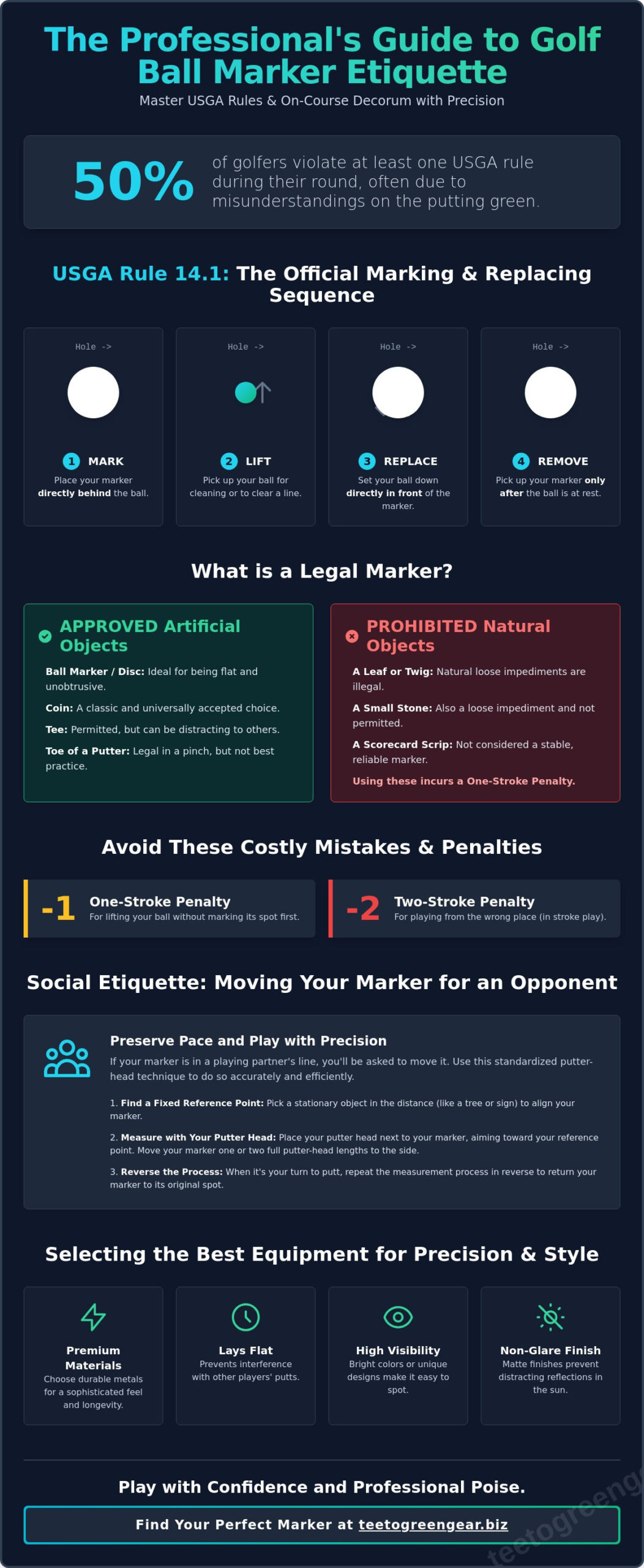
Failing to follow proper procedure can be costly to your score and your reputation. If you lift your ball without marking its spot, you face a one-stroke penalty under the official rules. Even more severe is the risk of playing from a wrong place, which can lead to a two-stroke penalty in stroke play. Beyond the scorecard, poor habits can create friction within your group. True golf ball marker etiquette ensures that your presence on the green is always a positive addition to the experience, preventing distractions that can undermine the focus of your playing partners.
The Official USGA and R&A Rules for Marking Your Ball
Adhering to the official framework provided by the USGA ensures your game remains beyond reproach. Rule 14.1 dictates that you must mark the spot of your ball before lifting it whenever the ball must be replaced on its original spot. To execute this with technical precision, you should place your marker directly behind the ball relative to the hole. This placement creates a clear reference point that allows you to return the ball to its exact previous location. When it’s time to play, simply reverse the process by setting the ball immediately in front of the marker. Only after the ball is securely at rest should you remove the marker from the surface. Following this specific sequence is the cornerstone of golf ball marker etiquette, as it eliminates any ambiguity regarding your ball’s position.
The rules are quite specific about the physical nature of the marker itself, requiring the use of an “artificial object.” This definition serves a practical purpose; it ensures the marker is stable and easily identifiable. Using natural loose impediments, such as a fallen leaf or a small twig, is strictly prohibited. If you use a natural object to mark your ball, you’re technically in violation of the rules and subject to a one-stroke penalty. Selecting a high-quality Magnetic Ball marker ensures you always have a legal, artificial equipment piece ready for every green, combining functional compliance with a refined aesthetic.
What Qualifies as a Legal Ball Marker?
Most players prefer specialized metal discs or coins because they lay flat and don’t interfere with the roll of other balls. In a pinch, the rules do allow for other pieces of equipment to serve as markers. You might use the toe of a club or a plastic tee to indicate the spot, provided you follow the same placement protocol. However, these larger items can be distracting to others. Discerning players typically stick to low-profile, artificial objects that signal a mastery of golf ball marker etiquette and a respect for the group’s visual field.
Accidental Movement of the Ball or Marker
Since the significant rules update in 2019, players are no longer penalized for accidentally moving a ball or a marker on the putting green. If you happen to kick your marker or drop your putter on the ball, there is no need for alarm. You simply replace the ball or marker on its original spot without any added strokes to your score. If the exact spot isn’t known, you must use your best judgment to estimate the location as accurately as possible. This rule change was designed to reduce unnecessary penalties and maintain the flow of the game, allowing you to focus on your performance rather than minor mishaps.
Beyond the Rulebook: Social Norms and Green Manners
While the official regulations provide a necessary framework, the true measure of a golfer’s character often lies in the unwritten social norms observed on the putting surface. Mastery of golf ball marker etiquette involves more than just knowing where to place a disc; it requires a keen awareness of your surroundings and a commitment to the group’s collective focus. One of the most critical manners to observe is respecting the “Line of Play.” Stepping on the path between a partner’s ball and the hole can compress the grass and alter the break of their putt. A discerning player always walks around the back of another player’s line, ensuring the integrity of the green remains undisturbed for everyone involved.
Professionalism on the course is a holistic experience that begins with your preparation. Arriving at the green with your marker already in hand demonstrates a respect for the pace of play and keeps the game moving smoothly. Fumbling through your pockets while others are ready to read their putts disrupts the rhythm of the round. This level of intentionality often extends to your attire. Choosing a Performance Tech Polo signals to your peers that you value both technical precision and aesthetic refinement. When you look the part of a dedicated enthusiast, your adherence to the game’s finer points feels like a natural extension of your commitment to excellence.
The Debate Over Poker Chips and Oversized Markers
Oversized markers and poker chips have become increasingly popular for their high visibility and personal flair, yet they remain a point of contention in many circles. While these larger items are easier to spot from across the green, they can become a significant visual distraction if they lie directly in a partner’s peripheral vision. If you find your marker is positioned near someone else’s line, it is a mark of superior golf ball marker etiquette to proactively offer to swap it for a smaller, flat coin. This gesture prevents your equipment from becoming an obstacle and shows that you prioritize your partner’s success as much as your own.
Shadow Etiquette on the Putting Green
The positioning of your body is just as important as the placement of your marker. You must be constantly mindful of where your shadow falls, especially during the early morning or late afternoon when shadows are longest. A shadow cast across a player’s line or even flickering in their peripheral vision can be incredibly disruptive. Position yourself well away from the line of sight of the player who is “away.” If you’re unsure if you’re in the way, simply ask before they begin their routine. This simple act of communication fosters a collaborative atmosphere and ensures every player can perform at their best without unnecessary interference.
How to Move Your Marker for an Opponent
During a competitive round, you’ll inevitably encounter a situation where your marker lies directly in a partner’s path. This might be a physical obstruction that could deflect a rolling ball, or it might simply be a mental distraction that breaks their concentration. Handling this request with grace and technical accuracy is a vital component of golf ball marker etiquette. It demonstrates that you’re a discerning player who values the integrity of the game and the success of your peers. When an opponent asks you to move your mark, you should respond with immediate cooperation, using a standardized method that ensures the ball can be replaced with absolute precision later in the sequence.
To perform this move correctly, you must rely on a fixed background object rather than a vague sense of direction. Choose a distant tree, a bunker edge, or a yardage post to serve as your alignment point. This ensures that when you move the marker back, you aren’t guessing the angle. Precision is the hallmark of a seasoned enthusiast; it separates those who merely play the game from those who master its nuances. If you’re looking to upgrade your on-course equipment to match this level of professional standards, you can shop our collection of premium Magnetic Ball markers and performance gear designed for the dedicated golfer.
Step-by-Step: Moving the Marker to the Side
The “Putter-Head” technique is the industry standard for moving a marker. First, identify your fixed target in the distance and align the heel or toe of your putter with your marker, pointing the clubhead directly toward that target. Carefully lift your marker and place it at the opposite end of the putter head. If your opponent requires more space, you can repeat this process for a “two-clubhead” move, provided you keep track of how many lengths you’ve shifted. This methodical approach ensures you’re never left questioning the ball’s original position when it’s time to putt.
The Golden Rule: Moving It Back
Forgetting to restore a marker to its original spot is one of the most common and avoidable penalties in golf. If you make a stroke from the moved position, you’ve played from a “wrong place,” which typically results in a two-stroke penalty in stroke play. To avoid this “double-move” trap, create a mental or physical trigger. Some players leave their putter cover or a glove near their bag as a reminder that their marker is currently “out of place.” As a final professional courtesy, don’t hesitate to ask your group, “Did I move this back?” before you address your ball. This simple verification protects your score and maintains the group’s collective focus on excellence.
Selecting the Best Equipment for Precision and Style
The transition from using pocket change to specialized equipment represents a shift toward a more disciplined and respectful approach to the game. While a simple coin technically meets the requirements of the rules, it often lacks the stability and visibility needed for high-level play on fast, modern greens. Modern players increasingly turn to magnetic golf ball markers because they offer a consistent weight and a polished finish that random change cannot match. This evolution in equipment is a practical application of golf ball marker etiquette, as it ensures your marker remains securely in place even in high winds and stays clearly visible to your partners without causing unnecessary distraction or glare.
Choosing the right materials is essential for maintaining both performance and decorum. Durable metals with non-glare finishes are the preferred choice for discerning players who understand that a reflective surface can be a nuisance on a sunny afternoon. These high-quality materials not only withstand the rigors of frequent use but also maintain a sophisticated appearance that reflects your pride in craftsmanship. Personalizing your experience with unique golf ball markers allows you to express your personality on the green while still adhering to the professional standards expected in a shared sporting environment. It’s about finding that intersection where functional improvement meets aesthetic refinement, ensuring your gear is as reliable as your stroke.
The Advantages of Magnetic Markers
The use of magnetic hat clips has fundamentally improved the pace of play by ensuring your marker is always “at hand” and ready for immediate use. You no longer need to fumble through your pockets or disturb your focus when you reach the green; instead, your marker is easily accessible on your brim, allowing you to mark your ball promptly. This seamless integration with apparel, such as the Classic Logo Snapback hats, allows for a more fluid transition from the fairway to the putting surface. The precision offered by these professional-grade markers provides a level of reliability that random objects simply cannot provide, helping you maintain your composure and professionalism throughout the entire round.
Coordinating Your Course Essentials
A clean, professional aesthetic is achieved when you coordinate your green-side essentials with the same care you apply to your swing mechanics. Matching your markers with other high-performance items, such as bamboo golf tees, creates a cohesive look that signals your expertise to the entire group. Before you step onto the first tee, ensure your “Big Three” of green-side etiquette, which includes your marker, your pitch tool, and your tees, are organized and ready for action. This commitment to aesthetic refinement and functional excellence ensures that your presence on the course is as impactful as your performance, fostering an environment of mutual respect and superior standards. Proper golf ball marker etiquette is, after all, the final touch on a well-played hole.
Mastering the Green with Professional Poise
Refining your approach to the putting surface is more than a technical exercise; it’s a commitment to the enduring traditions of the game. By mastering the official regulations of Rule 14.1 and embracing the subtle social nuances of shadows and lines, you ensure every round is played with absolute integrity. This blend of technical accuracy and social awareness represents the pinnacle of golf ball marker etiquette, allowing you to navigate every green-side scenario with the confidence of a seasoned expert. You’ve now gained the insights needed to maintain the pace of play while showing deep respect for your partners’ focus.
As a veteran-owned and operated provider, we’re dedicated to crafting high-performance materials designed for the discerning golfer who values excellence in every detail. Our commitment to quality ensures that your gear is as reliable as your stroke, helping you bridge the gap between functional improvement and aesthetic refinement. Elevate your game with our precision Magnetic Ball Markers and discover how superior design can enhance your presence on the course. Step onto the next green with the poise of a leader and the precision of a professional.
Frequently Asked Questions
Where exactly should I place my ball marker?
You should place your marker directly behind the ball on the line between the ball and the hole. This positioning provides a consistent reference point for replacing the ball with technical precision. By following this standard protocol, you ensure that your ball returns to its exact original location. This simple act is a fundamental requirement of the official rules and reflects the professional green-side manners expected of every dedicated golfer.
Can I use a poker chip as a ball marker in a tournament?
Poker chips are technically legal markers because they qualify as artificial objects under the official rules. While the USGA permits their use, you should be mindful of their height and visibility in a tournament setting. If your chip lies in a partner’s peripheral vision or line of play, standard golf ball marker etiquette suggests swapping it for a flatter coin to minimize distractions and maintain a respectful atmosphere.
What happens if I accidentally move my ball while marking it?
There is no penalty if you accidentally move your ball or marker while in the process of marking it on the putting green. This 2019 rule update ensures that minor mishaps don’t result in unnecessary score inflation. Simply restore the ball to its original estimated spot before continuing your play. This adjustment allows you to focus on your performance rather than fearing the consequences of accidental infractions during your routine.
Do I have to move my marker if it is in someone’s line?
You must move your marker if another player requests it because it interferes with their line or mental focus. Using your putter head to measure the distance ensures the marker is shifted with absolute accuracy. Proactively asking your group if your marker is in the way demonstrates a sophisticated level of on-course awareness and respect for the group’s collective success, ensuring everyone has a clear path to the hole.
Is a plastic tee a legal ball marker according to USGA rules?
A plastic tee is considered a legal ball marker under the USGA definition of an artificial object. While it’s a reliable backup if you’ve misplaced your primary marker, it’s not the most professional choice due to its height and potential to obstruct. Most seasoned enthusiasts prefer low-profile metal discs that stay out of the way and don’t risk deflecting a partner’s rolling ball during their stroke on the green.
How do I remember to move my ball marker back to its original spot?
Creating a physical reminder is the most effective way to remember to restore your marker’s position. Many players place their putter cover or a glove in an unusual spot to trigger their memory before they address the ball. Always verify the position with your group as a final professional courtesy. This simple step protects your score from the heavy two-stroke penalty associated with playing from a wrong place.
Can I clean my ball after I have marked and lifted it?
You are absolutely permitted to clean your ball once it has been marked and lifted from the putting green. Rule 14.1c explicitly allows this practice, which is essential for removing sand or debris that could alter your putt’s trajectory. Taking the time to clean your ball ensures that your equipment performs at its peak. This habit allows for the precise execution of your chosen line and maintains the integrity of your performance.
What is the penalty for not marking your ball before lifting it?
Failing to mark your ball before lifting it results in a one-stroke penalty. This rule is strictly enforced to ensure that every ball is replaced with the precision required for fair competition. Maintaining proper golf ball marker etiquette by always placing your marker first protects your scorecard. It also demonstrates your commitment to the game’s official standards and your disciplined pursuit of excellence on every hole of the course.
Disclaimer
“Tee To Green Gear utilizes modern content and SEO technologies to help deliver golf-related articles, product insights, and apparel content. All published material is reviewed for quality, accuracy, and brand consistency.”
