

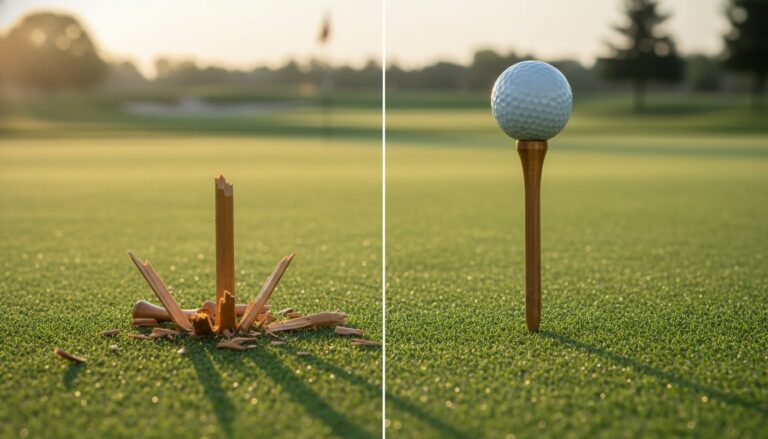
If you find yourself reaching into your bag for a fresh peg after every single drive, you aren’t just losing your rhythm; you’re witnessing the limitations of traditional hardwood. When evaluating bamboo golf tees vs wood in 2026, the choice is no longer just about environmental ethics, it’s about a fundamental shift in material integrity that directly impacts your performance. Most dedicated golfers share the frustration of snapping a tee on the first hole or dealing with the inconsistent heights often found in bulk wood packs. It’s a common struggle that leads to a distracted setup and unnecessary waste across the tee box.
This comparison will reveal why the modern player is trading fragile timber for the superior strength of bamboo, a material that offers three to five times the durability of its wooden counterparts. We’ll explore the meticulous craftsmanship behind these sustainable alternatives and provide a detailed breakdown of how they offer better consistency for your drive setup. You’ll gain a clear understanding of the cost-per-round benefits and the precision engineering that allows a single bamboo tee to withstand multiple high-velocity impacts without compromising its form or the pristine condition of the fairway.
Key Takeaways
- Understand the material science behind bamboo’s tensile strength, which offers a flexible durability that hardwood simply cannot match.
- Examine the performance data in the bamboo golf tees vs wood comparison to see how reduced breakage leads to a more consistent drive height and setup.
- Calculate the long-term value of a resilient tee that reduces your cost-per-round while providing a more premium, professional experience.
- Discover the environmental benefits of choosing a rapidly renewable grass that biodegrades naturally, ensuring your game leaves no lasting mark on the course.
- Learn how selecting high-quality essentials supports a sophisticated approach to the game and enhances your overall performance from the first tee.
The Evolution of the Golf Tee: Why Tradition is Meeting Innovation
Before the early 20th century, golfers literally carried buckets of sand to create small mounds on every tee box. This messy, inconsistent method eventually gave way to the first patented pegs, marking a significant milestone in The Evolution of the Golf Tee. While these early innovations focused on convenience, they established a reliance on hardwood that has persisted for over a century. For decades, the wooden tee was the undisputed standard, accepted by professionals and amateurs alike as a simple, disposable tool of the trade.
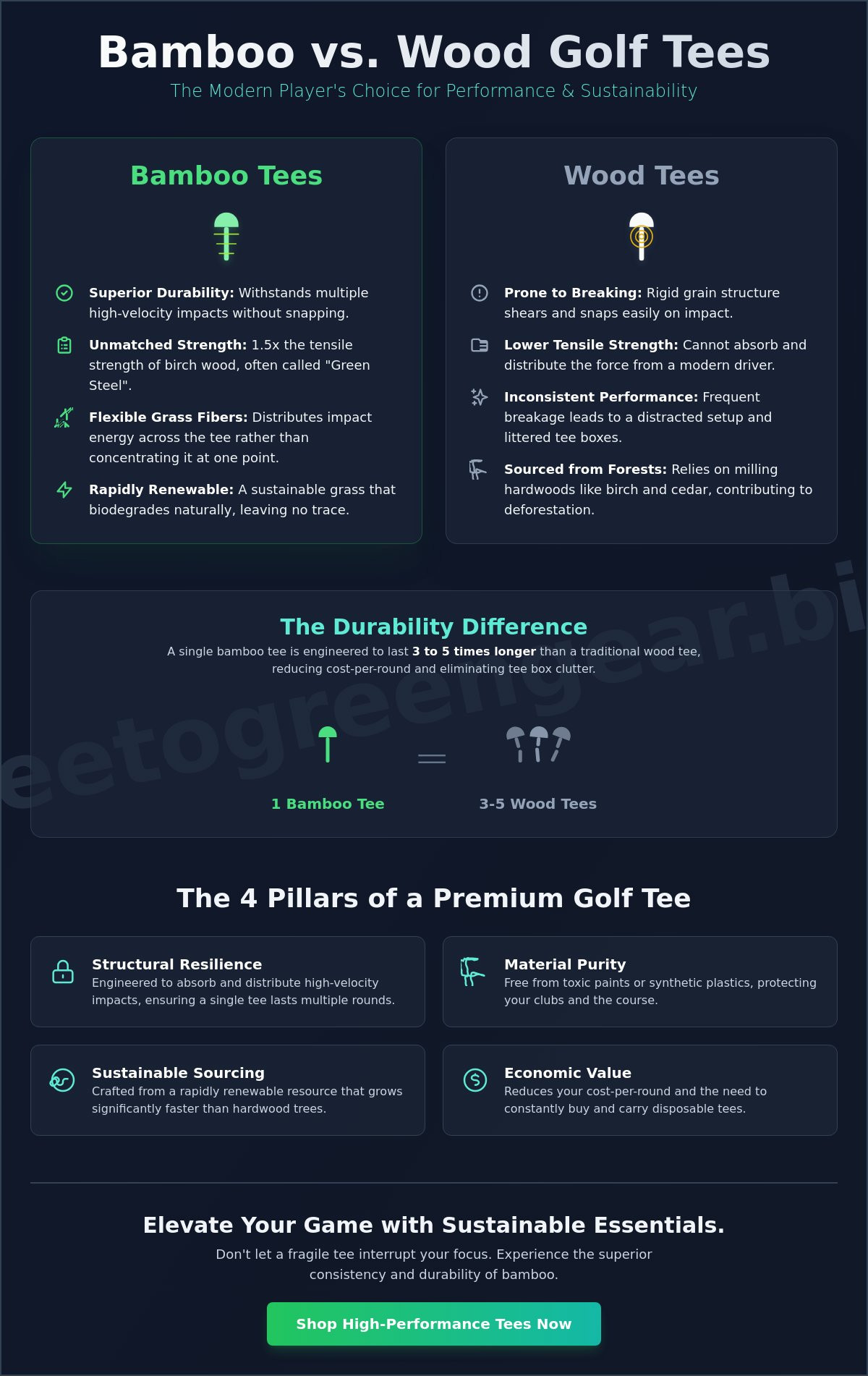
In 2026, we’re seeing a definitive shift toward high-performance, sustainable materials in both professional and amateur play. The search for the “perfect” tee has evolved into a quest for a specific trifecta: exceptional durability, cost-efficiency, and a positive environmental impact. When comparing bamboo golf tees vs wood, the modern player isn’t just looking for a cheaper alternative; they’re looking for a superior engineering solution that enhances the ritual of the drive. The modern definition of a premium tee now rests on four essential pillars:
- Structural Resilience: The ability to survive multiple high-velocity drives without shearing.
- Material Purity: A composition free from toxic paints or synthetic plastics.
- Sustainable Sourcing: Using rapidly renewable resources that don’t deplete old-growth forests.
- Economic Value: A lower cost-per-round achieved through superior product longevity.
The Legacy of Hardwood Tees
Traditional woods like cedar and birch became the industry standards because they were abundant and easy to mill into uniform shapes. These hardwoods provided a stable base for the ball, yet their rigid grain structure remains their greatest flaw. When a high-velocity driver head meets a wooden peg, the impact follows the natural lines of the wood grain, causing it to shear and snap almost instantly. This fragility forces golfers to carry handfuls of replacements, leading to cluttered bags and littered tee boxes. It’s a frustrating cycle that interrupts the focus required for a consistent game, as the modern game demands more than what traditional timber can provide.
The Rise of the Eco-Conscious Golfer
Modern players are increasingly aware of the legacy they leave on the course. There’s a growing movement to eliminate plastic waste from the fairway, yet many find that traditional wood isn’t the perfect solution either. Sustainability has become a hallmark of the discerning insider, someone who understands that excellence on the green extends to the thoughtful selection of materials. This shift is driving interest in bamboo, which offers the biodegradability of wood with a strength profile that challenges the status quo. It’s about finding that intersection of functional improvement and aesthetic refinement. If you’re looking to upgrade your entire approach, you can explore high-performance options at our online shop to find gear that matches this elevated standard.
Material Science: Comparing the Structural Integrity of Bamboo and Hardwood
To understand why a tiny peg can withstand a 110-mph driver swing, we have to look at the botanical foundation of the materials. Bamboo is technically a grass, not a wood. This distinction is vital because grasses are evolved to be flexible and resilient under high-stress conditions like heavy winds or physical impact. While a tree grows by adding rigid rings of heartwood, bamboo grows through a complex system of vascular bundles that run vertically. This unique cellular structure allows the material to distribute energy across its entire length rather than concentrating stress at a single point.
When evaluating the material science of bamboo golf tees vs wood, the most striking difference is tensile strength. In the world of sustainable construction, bamboo is often referred to as “green steel” because its fibers can withstand immense pulling and bending forces. Bamboo’s fiber density provides a 1.5x strength advantage over standard birch wood, allowing it to absorb impact rather than shattering. This structural resilience is exactly why the debate over bamboo golf tees vs wood has shifted from eco-friendliness to pure performance.
Understanding Tensile Strength in Golf
The lateral force of a driver head creates a massive shear stress on a golf tee. Hardwood tees, while sturdy, are rigid and brittle. When the clubhead makes contact, the wood has no “give,” leading to the clean snap that most golfers are used to seeing in the tee box. Bamboo’s longitudinal fibers act like tiny shock absorbers, allowing the tee to flex slightly at the moment of impact. This flexibility is further enhanced by bamboo’s natural moisture resistance. While traditional wood can become waterlogged and soft or overly dry and brittle, bamboo maintains its structural integrity over 18 holes, even in damp conditions. While the American Hardwood Information Center comparison highlights the long-standing durability of traditional hardwoods in furniture and flooring, the high-impact environment of a golf course favors the elastic strength of bamboo.
Why Grain Direction Matters
Hardwood tees possess a natural grain that essentially acts as a pre-installed fault line. If the impact of your club isn’t perfectly aligned with the strength of that grain, the tee will fail along those microscopic layers. Bamboo doesn’t have a traditional grain; instead, it’s a composite of dense fibers held together by a natural lignin. This makes it incredibly resilient to multi-directional forces. Some critics suggest bamboo can be brittle, but this is usually a result of poor manufacturing or using immature stalks. High-quality bamboo tees are harvested at peak maturity to ensure the fibers are at their densest. Finding a tee that stays intact through the back nine allows you to focus on your swing rather than your inventory, which is why many players are upgrading their essentials at our online shop.
Performance on the Course: Durability, Friction, and Consistency
Stepping onto the first tee with a product you trust changes the entire complexion of your opening drive. While the material science we previously discussed establishes a foundation of strength, the real value of any equipment is proven through its on-course performance. When observing the practical application of bamboo golf tees vs wood, the difference in longevity becomes immediately apparent. Most golfers are accustomed to the “one-and-done” nature of traditional hardwood pegs, yet the modern game requires a more resilient solution that doesn’t shatter under the force of a well-timed swing.
A critical but often overlooked element in this comparison is the friction coefficient of the material surface. Raw wood is naturally porous and can possess a microscopic roughness that creates a “grab” effect against the ball’s dimples at the moment of launch. In contrast, bamboo features a naturally smooth, almost waxy finish that facilitates a cleaner release. This reduction in friction helps minimize unwanted spin and supports a more efficient transfer of energy from the clubhead to the ball. For a deeper dive into the physics of impact, you can explore our guide on Durable Golf Tees: Myth-Busting the Science.
The Durability Factor
Real-world data indicates that a single bamboo tee typically lasts between three and five drives, whereas a standard wooden tee often survives only one to three impacts. This 3x to 5x increase in durability means you’ll spend significantly less time searching the grass for a broken tip or reaching into your bag for a replacement. There is a distinct psychological benefit to this reliability. Knowing your setup will remain intact allows you to maintain a steady rhythm throughout your round, fostering a sense of confidence that carries over from the tee box to the green. It’s about eliminating the small frustrations that can clutter a player’s mental game.
Consistency and Launch
Consistency in manufacturing is another area where bamboo excels over traditional timber. Because bamboo stalks grow with remarkable uniformity, the resulting tees offer more consistent dimensions and structural integrity across every pack. This precision is vital for players who rely on exact tee heights to optimize their launch angles.
- Secure Support: The rigid nature of bamboo fibers ensures the ball remains stable, even at the higher heights required for modern 460cc drivers.
- Uniform Manufacturing: Unlike birch or cedar, which can vary in density based on the health of the tree, bamboo provides a predictable feel every time you press it into the turf.
- Cleaner Release: The smooth surface finish minimizes the physical interaction between the tee and the ball, promoting a more neutral launch.
Professional-grade bamboo options are quickly becoming the preferred choice for those who view every detail of their setup as an opportunity for refinement. You can find these high-performance essentials at our online shop, where we prioritize the intersection of quality and craftsmanship.
The Environmental and Economic Case for Switching to Bamboo
While the structural advantages of bamboo are compelling, the true brilliance of the material lies in its lifecycle. Most hardwood trees used for traditional equipment require decades of growth before they are ready for harvest. Bamboo reaches maturity in 3-5 years, making it the most renewable resource in golf gear. This rapid regeneration ensures that the production of high-performance equipment doesn’t outpace the planet’s ability to recover. When analyzing bamboo golf tees vs wood, we must consider the legacy left behind on the course. Bamboo is a type of grass that biodegrades naturally and efficiently, returning to the earth far more gracefully than treated hardwoods or synthetic alternatives.
Eco-Friendly Fairways
Tee litter is a persistent issue for course superintendents. Shards of broken hardwood can be surprisingly resilient, often dulling expensive mower blades or creating debris that affects soil health over time. Bamboo is the logical successor to the plastic pegs that many elite clubs have already banned. Because it is a natural fiber, it poses no threat to the local ecosystem or the precision machinery used to maintain the pristine condition of the greens. Choosing these sustainable essentials is a hallmark of the discerning golfer. By selecting gear from a veteran-owned business that prioritizes meticulous material selection, you’re supporting a commitment to excellence that extends beyond your own scorecard. It’s a thoughtful way to ensure the game remains beautiful for the next generation of players.
Economic Value for the Discerning Golfer
The “cost per round” analysis reveals a hidden advantage for those who prioritize quality over bulk quantity. Many players assume that wood is the more economical choice because large packs are inexpensive, yet they fail to account for the frequency of replacement. If you’re snapping several wooden pegs on every hole, you’re essentially throwing money into the rough. A single pack of high-quality bamboo tees offers significantly better longevity. Because they are three to five times more durable than hardwood, a pack of 100 bamboo tees can easily outlast a bag of 500 wood tees over a full season. This makes them a much smarter investment for the high-volume player who values both performance and efficiency. For those ready to make the transition, you can find more insights in our Where to Buy Bamboo Golf Tees guide.
Investing in superior materials is the most direct way to eliminate the small frustrations that interrupt your focus on the box. Upgrade your kit with sustainable bamboo tees today and experience the intersection of professional-grade durability and environmental responsibility.
Elevating Your Game with Sustainable Essentials from Tee to Green Gear
Choosing between bamboo golf tees vs wood represents a pivotal shift toward a more intentional and sophisticated approach to your game. At Tee to Green Gear, we’ve harnessed the inherent strength of bamboo and applied a level of craftsmanship that elevates it from a simple tool to a performance essential. Our Bamboo Golf Tees are designed for the golfer who demands maximum durability and refuses to be hindered by the frequent snapping of inferior hardwood pegs. By integrating these into your bag, you’re opting for a product that mirrors the precision and reliability of the rest of your high-end equipment.
The Complete Performance Kit
A truly exceptional round is the result of many refined details working in harmony. While our tees establish the foundation for your drive, they’re part of a broader ecosystem of gear designed to enhance your physical and mental performance. You’ll find that our Performance Tech Polo offers the elite comfort required for a long day on the course, utilizing moisture-wicking fabrics that move with your body rather than against it. When you transition to the putting surface, our Magnetic Ball marker provides a sophisticated solution for marking your position with ease and speed. To top off your look, our Classic Logo Snapback or our versatile Golf Hats snap back offer the perfect blend of athletic style and practical protection, ensuring you look as sharp as you play.
Why Choose Tee to Green Gear?
Tee to Green Gear stands apart because of our unwavering commitment to veteran-owned excellence and meticulous material selection. We don’t just follow trends; we solve common course frustrations through better design and forward-thinking engineering. Our focus on high-end performance tech ensures that every stitch in our apparel and every fiber in our tees serves a specific purpose. We invite you to join a community of golfers who understand that the right gear is a partner in their success. It’s time to move beyond the limitations of traditional timber and embrace a more resilient, sustainable future. This is the personality of a brand that values tradition but isn’t afraid to innovate for the sake of better results. Shop our collection now and experience the definitive performance difference that comes from a brand dedicated to your best game.
Master the Modern Tee Box
The transition toward more resilient and responsible equipment is a natural progression for the player who values both tradition and technical excellence. When you weigh the practical benefits of bamboo golf tees vs wood, it’s clear that the modern game demands the high-tensile strength and consistent performance that only premium bamboo can provide. By choosing these precision-engineered essentials, you aren’t just reducing waste on the course; you’re ensuring that your drive setup remains stable and reliable through every hole. As a veteran-owned and operated brand, we take pride in our meticulous material selection to ensure your gear meets the highest standards of durability.
Choosing eco-friendly materials doesn’t mean you have to compromise on the precision your game requires. It’s about investing in high-quality tools that reflect your commitment to the sport and the environment. Upgrade your gear with our sustainable Bamboo Golf Tees today and experience the difference that superior craftsmanship makes. We look forward to seeing you achieve your best performance yet on the green.
Frequently Asked Questions
Are bamboo golf tees stronger than wood?
Yes, bamboo is significantly stronger due to its higher tensile strength and unique cellular structure. When evaluating bamboo golf tees vs wood, you’ll find that bamboo distributes energy across vertical vascular bundles rather than snapping along a rigid grain. This allows the material to withstand high-velocity impacts that would typically cause a standard wooden peg to shatter on the first swing.
Do bamboo golf tees break easily?
No, they are specifically designed to resist snapping under the intense pressure of a modern driver swing. Because bamboo is naturally flexible, it absorbs the lateral force of the clubhead by bending slightly rather than breaking. This resilience is a primary reason golfers prefer these sustainable alternatives when they want to maintain a consistent setup throughout multiple holes without interruption.
Are bamboo golf tees biodegradable?
Yes, bamboo is a fully biodegradable material that decomposes naturally without leaving harmful residues in the soil. Unlike plastic alternatives that persist in the environment for centuries, these natural fibers break down into organic matter over a relatively short period. This ensures that any broken pieces left on the fairway don’t negatively impact the local ecosystem or the aesthetic of the course.
Why are bamboo golf tees better for the environment than wood?
Bamboo is a more sustainable choice because it reaches maturity in just 3 to 5 years, whereas hardwood trees require decades of growth. This rapid regeneration makes it a highly renewable resource that doesn’t contribute to deforestation. Additionally, bamboo requires significantly less water and fewer pesticides to thrive, making it the most eco-friendly option for the discerning player who values environmental responsibility.
Do bamboo golf tees damage mower blades?
No, bamboo fibers are organic and don’t cause the same level of wear on mower blades as plastic or metal pegs. Course superintendents often encourage the use of bamboo because it shatters into soft, biodegradable splinters that pass through maintenance equipment safely. This meticulous material selection helps preserve the pristine condition of the greens while protecting expensive machinery from unnecessary damage.
Can I use bamboo golf tees in professional tournaments?
Yes, bamboo tees are entirely legal for use in professional and amateur competitions governed by the USGA and R&A. According to Rule 6.2, a tee must simply meet specific dimension requirements and cannot be designed to indicate the line of play. As long as your bamboo peg is under 4 inches in length, you can use it confidently in any sanctioned event around the world.
How long does a single bamboo golf tee last compared to wood?
A single bamboo tee typically lasts between three and five drives, which is a significant improvement over traditional hardwood. Most wooden pegs survive only one or two high-impact swings before shearing along the grain. This increased longevity provides better value for the high-volume player and reduces the frequency of reaching into your bag for a fresh replacement during a focused round.
What is the best length for a bamboo golf tee?
The ideal length depends on your equipment, but 3.25 inches is the standard recommendation for modern 460cc drivers. This length allows you to achieve the high-launch angles required for maximum distance with the big stick. For those using smaller woods or irons on the tee, a shorter 2.125-inch bamboo peg provides the necessary stability for a more controlled and lower-trajectory shot.
Disclaimer
“Tee To Green Gear utilizes modern content and SEO technologies to help deliver golf-related articles, product insights, and apparel content. All published material is reviewed for quality, accuracy, and brand consistency.”
